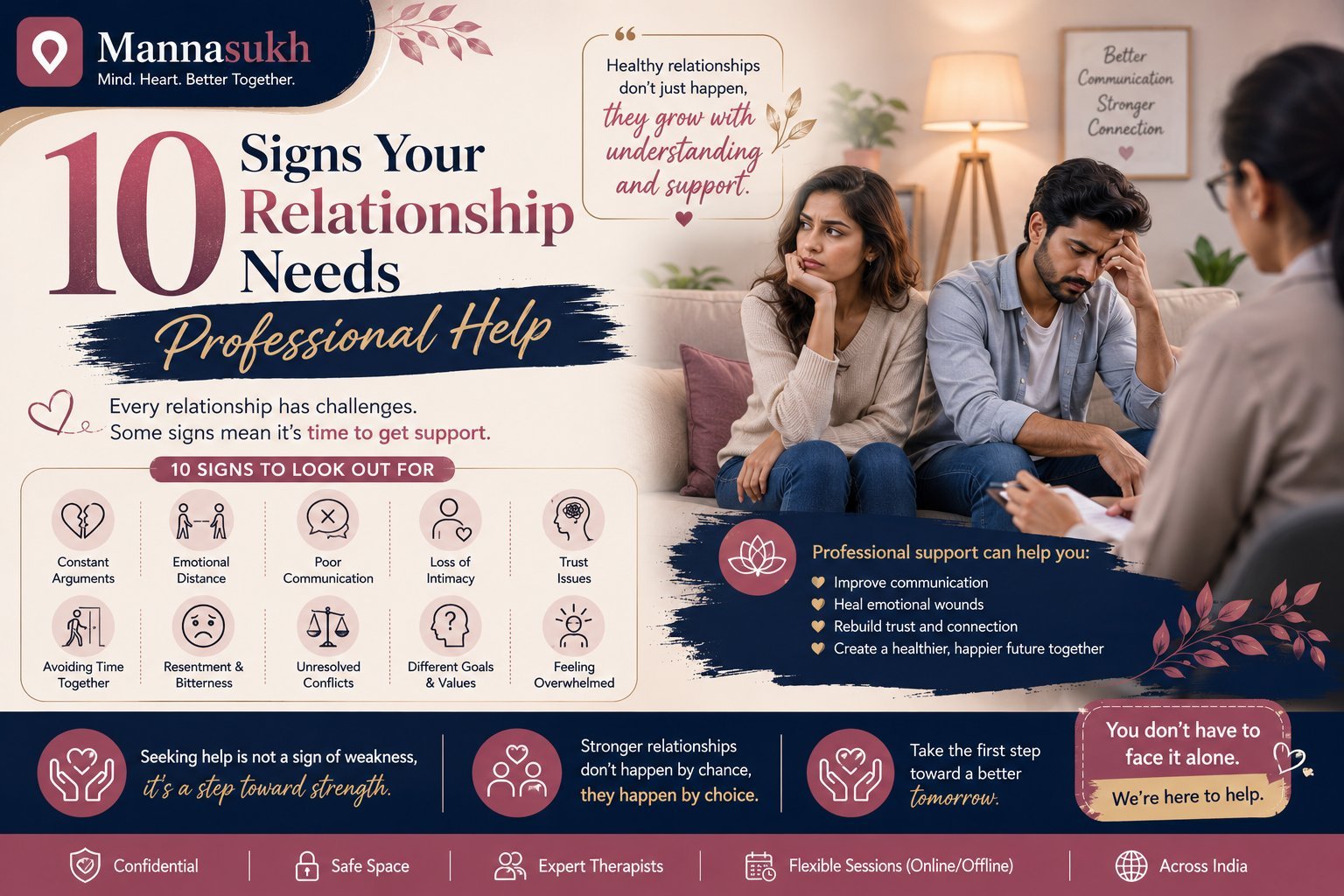
10 Signs Your Relationship Needs Professional Help
All relationships have challenges to face. That's normal. However, if these issues recur over time and no change occurs, it is a serious problem. Conflict with others doesn't begin at a high level. They begin slowly and quietly until one day, you and your spouse don't converse very much. A few couples will ignore these warning signs for months and months before finally seeking assistance. This article discusses 10 obvious signs of your relationship problems that require more than a weekend discussion. It also explains how a relationship therapist can help you fix it before it escalates further.
Why Relationship Problems Get Worse Over Time
Problems in relationships typically don't just fall into your lap. They accumulate from little things that you don't pay attention to. Perhaps you're working all day long. Perhaps you feel that the stress of money makes you impatient. Perhaps a newborn fills all your spare time that you used to share with him/her. This doesn't mean that you or your partner are bad or bad people. Life is hectic and busy people don't have time for hard conversations. Which is how little relationship problems become giant problems.
Many couples are also embarrassed to ask for assistance. Their thoughts about therapy are that it is a sign of failure in the relationship. In fact, it is the other way round. The earlier, the better, time to seek assistance from others for relationship issues, as couples who do so resolve problems in their relationship more than those who wait until it has completely broken down.
10 Signs Your Relationship Needs Professional Help
If communication keeps breaking down, trust has been damaged, conflicts never get resolved, or you and your partner feel emotionally disconnected, your relationship may benefit from professional counselling. Early support can prevent small problems from becoming long-term relationship problems.
1. You Keep Having the Same Arguments
If every disagreement ends with the same unresolved conversation, it usually means the real issue has never been addressed. Repeating the same conflict without progress is one of the strongest signs that professional help may be needed.
2. Communication Has Become Negative
Healthy relationships rely on open and respectful communication. If conversations are filled with sarcasm, criticism, silence, or constant misunderstandings, it becomes difficult to solve problems together.
3. You Feel Lonely Even When You're Together
Feeling emotionally disconnected despite spending time together often signals a deeper issue. Physical presence alone cannot replace emotional intimacy.
4. Trust Has Been Broken
Whether the cause is dishonesty, secrecy, or infidelity, broken trust rarely heals without honest communication and consistent effort. A relationship therapist can help both partners rebuild trust safely.
5. Physical Affection Has Disappeared
A noticeable decline in hugs, kisses, hand-holding, or intimacy may reflect unresolved emotional distance rather than simply a busy lifestyle.
6. Difficult Conversations Are Always Avoided
Avoiding important discussions might reduce conflict temporarily, but unresolved issues continue to grow beneath the surface and often return in more damaging ways.
7. Your Relationship Feels Like a Competition
Keeping score over chores, apologies, or sacrifices creates resentment instead of teamwork. Healthy relationships focus on solving problems together rather than proving who is right.
8. You Confide in Others Instead of Your Partner
When friends or coworkers know more about your feelings than your partner, emotional intimacy begins to weaken. This distance can make resolving relationship problems even harder.
9. You've Thought About Leaving the Relationship
Occasional frustration is normal, but regularly imagining life without your partner may indicate deeper dissatisfaction that deserves attention before making major decisions.
10. Small Issues Turn Into Major Fights
If minor disagreements quickly escalate into intense arguments, unresolved emotions or communication patterns may be driving the conflict.
How Couples Counselling can resolve relationship issues.
A competent couples counsellor does not side with either partner. Their role is to help you and your partner notice your two-way pattern, since most couples cannot see their pattern. You experience your relationship issues on a daily basis so you can't see them clearly. The outside view is provided by a counsellor.
What Happens in a Counselling Session
At the first Session, you and your partner discuss the issue and the counsellor listens. Everyone is given an opportunity to speak his/her side without being interrupted. In some instances, it is the first 'true' talk you've had in months. The counsellor next identifies the pattern of your conflicts and provides you with some easy steps to take until your next session. It may be a bit awkward at first, but if you both are dedicated to it, it will be okay.
What a Good Relationship Therapist Actually Does
A relationship problem therapist who is skilled will not choose a winner. They aim to ensure that both partners understand what is fueling the conflict, rather than engaging in the same discussion about the same surface-level issue each week. Sessions stay private. Nobody judges you. Most therapists are not interested in lengthy discussions regarding childhood rather they're interested in how to help you practically.
Building Healthy Relationships After Therapy
There will be no quick fixes with therapy. It provides you with tools rather than it. Couples employing these instruments are less likely to argue and can bounce back more quickly from an argument. A healthy relationship doesn't mean there are no conflicts. They're both aware of how to reunite after a quarrel.
Frequently Asked Questions
What are the most common relationship problems?
The most common relationship problems include poor communication, lack of trust, financial stress, emotional distance, frequent arguments, different expectations, and reduced intimacy. While these challenges are common, they can become more serious if left unresolved for a long time.
How do I know if my relationship needs professional help?
If you and your partner keep having the same arguments, struggle to communicate respectfully, avoid important conversations, feel emotionally disconnected, or have considered separation, it may be time to seek professional relationship counselling. Early intervention often leads to better outcomes.
Does couples counselling really work?
Yes. Couples counselling can help partners improve communication, rebuild trust, resolve recurring conflicts, and strengthen emotional connection. Success depends on both partners being willing to participate honestly and consistently.
Can relationship problems be solved without therapy?
Some relationship problems can improve through honest communication, mutual effort, and healthy conflict resolution. However, if the same issues continue despite repeated attempts to fix them, professional support can provide practical tools and unbiased guidance.
How long does couples therapy usually take?
The length of couples therapy varies depending on the challenges involved. Many couples begin noticing positive changes within 8 to 12 sessions, while more complex issues may require longer-term counselling.
Final Thoughts
Every relationship experiences challenges, but persistent conflict, emotional distance, and broken trust shouldn't be ignored. Seeking professional help doesn't mean your relationship has failed. It shows a willingness to work together and create healthier patterns. If you recognize several of these warning signs, speaking with a qualified relationship therapist could be the first step toward rebuilding trust, improving communication, and strengthening your relationship.